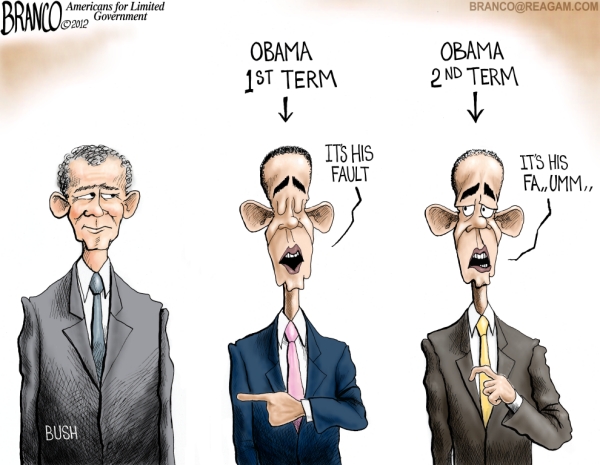
Our government has spent much money bailing out General Motors, Chrysler, Wall Street, etc. And it has given billions to green companies, like Solyndra. They do this because, they claim, government investment is crucial to innovation.
They say that windmills won't exist if the government does not subsidize them. And they're right about that because windmills are not cost efficient and are not an economical way to create energy. Inside information: a windmill will take 10 years to break even, and will be obsolete in 20. No non-subsidized companies will accept to wait 10 years before making money. A private company would not like to wait five years before making a profit.
Are there any examples of subsidized companies working well, or not working at all?
Burt Folsum has some examples:
What examples from U.S. history support the transfer of funds and
power from private to government control? In other words, do we have
historical precedents for successful government subsidies to private
companies? Also, do businesses owned by the federal government perform
well?
Let’s review some historical examples. President George Washington
experimented with government control when he supported passage of a law
to set up a federally funded fur company for the Northwest Territory.
President Washington thought this government-run company would help to
prevent the British from encroaching on U.S. land, because agents of the
British-owned Hudson Bay Company bought furs from the Indians in the
Northwest.
Unfortunately, Indians and trappers alike despised the inefficient
American company, but John Jacob Astor became a part of the solution. As
a new resident of the United States, Astor founded his own private
company and successfully bought furs from the Indians, making a fortune
in the process. Under President Monroe, the U.S. finally disbanded the
nearly bankrupt government company, sold its assets, and allowed the
more competent private U.S. companies to do all the nation’s fur
trading.
During the Civil War, President Lincoln signed a bill to build the
country’s first transcontinental railroad from Omaha, Nebraska, to
Sacramento, California. The federal government would do the financing.
After granting roughly $60 million in land and another $60 million in
federal loans, the bureaucrats were in dismay. The Union Pacific and
Central Pacific had done a poor job of construction, and the road went
bankrupt several times by the end of the 1800s.
Airplanes were another example. By 1900, some Americans worried that
Europeans would invent the airplane and possibly use it to dominate
other countries (including the U.S.) militarily. Government support, so
the argument went, was therefore essential to stimulate Americans to
inventive greatness. Samuel Langley, head of the Smithsonian
Institution, received a federal subsidy to continue his research into
manned flight. Langley conducted two public experiments with his
federal dollars and launched his inventions on the edge of Washington,
D.C. Unfortunately, both flights crashed ignominiously into the Potomac
River.
Within two weeks after the second launch, the Wright
Brothers–two bicycle mechanics from Dayton, Ohio–flew the first
successful airplane at Kittyhawk, North Carolina, financing the venture
with $2,000 of their own money.
For some reason, federal subsidy and control often diminish the
chance of an enterprise being successful. In some cases, this occurs
because federal officials don’t have the same abilities or incentives as
entrepreneurs. Another reason is that federal control equals political
control of some kind. What is best for politicians politically is not
often what is best for businesses economically. Polticians want to win
votes, and they can do so by giving targeted voters benefits while
dispersing costs to others.
Asking the right questions focuses attention in the right direction:
What federal subsidies and takeovers have ever improved the prosperity
or quality of life for most American citizens? Until advocates of
government-run businesses can answer that question clearly and with
persuasive evidence, we should reject further federal intrusion in the
U.S. economy.
Sunday, January 27, 2013

Saturday, January 26, 2013
We Sure Brutalize Our Language
A Wisconsin school board candidate appeared to display poor judgment when he posted a picture of himself on Facebook in 2011 brandishing a knife in a Kenosha high school classroom and pointing it towards a girl’s throat, EAGnews.org reported."Poor judgement"? How does the idea to do that even enter your head?
-Townhall
Friday, January 25, 2013
Gun "Facts" from the Left are Lies
Guess what!
People who support gun control, like President Obama, are willing to lie and deceve in order to convince you that they are right!
Raise your hand if you're surprised.
Apparently the President has claimed, "as many as 40 percent of guns are purchased without a background check."
John Lott points out that this "fact" missed a few things, and is a bit out of date.
A twenty year old 251 person survey of people's perceptions. Does that sound like truthful "facts and stats"?
If you come across someone who uses this stat, then tell them that Washington D.C. with its near total gun ban sees 292 murders per year. That was the number of murders in 1995. Apparently it was 108 last year, but saying 292 per year is a better stat then the 40% number for several reasons.
Saying that Washington D.C. has 292 murders per year is more accurate than claiming that 40% of guns are purchased without background checks because:
***
Despite his best attempts to reassure them — “I see no movement, no talk, no bills, no nothing” — they remained skeptical.
In other news: "On Thursday a group of Democratic senators led by Dianne Feinstein of California plans to introduce a bill that would outlaw more than 100 different assault weapons, setting up what promises to be a fraught and divisive debate over gun control in Congress in the coming weeks."
h/t: Vox Day
***
There is no plan to ban guns coming!
40% of guns are acquired without a background check!
Mass shootings all occur in gun free zones!
Stop opposing sensible gun control!
People who support gun control, like President Obama, are willing to lie and deceve in order to convince you that they are right!
Raise your hand if you're surprised.
Apparently the President has claimed, "as many as 40 percent of guns are purchased without a background check."
John Lott points out that this "fact" missed a few things, and is a bit out of date.
Actually, the number reported was a bit lower, 36 percent, and as we will see the true number of guns “sold” without check is closer to 10 percent. More important, the number comes from a 251-person survey on gun sales two decades ago, early in the Clinton administration. More than three-quarters of the survey covered sales before the Brady Act instituted mandatory federal background checks on February 28, 1994. In addition, guns are not sold in the same way today that they were sold two decades ago.(disclosure: a close relative had an FFL license in the '80s, he bought and sold guns but had no gun store. Because of the laws he no longer has the FFL license.)
The number of federally licensed firearms dealers (FFLs) today is only a fraction of what it was. Today there are only 118,000; while back in 1993 there were over 283,000. Smaller dealers, many operating out of their homes, were forced out by various means, including much higher costs for licenses.
The survey asked buyers if they thought they were buying from a licensed firearms dealer. While all FFLs do background checks, those perceived as being FFLs were the only ones counted. Yet, there is much evidence that survey respondents who went to the very smallest FFLs, especially the “kitchen table” types, had no inkling that the dealer was actually “licensed.” Many buyers seemed to think that only “brick and mortar” stores were licensed dealers, and thus reported not buying from an FFL when in fact they did.
But the high figure comes primarily from including such transactions as inheritances or gifts from family members. Putting aside these various biases, if you look at guns that were bought, traded, borrowed, rented, issued as a requirement of the job, or won through raffles, 85 percent went through FFLs; just 15 percent were transferred without a background check.
If you include these transfers either through FFLs or from family members, the remaining transfers falls to 11.5 percent.
We don’t know the precise number today, but it is hard to believe that it is above single digits.
A twenty year old 251 person survey of people's perceptions. Does that sound like truthful "facts and stats"?
If you come across someone who uses this stat, then tell them that Washington D.C. with its near total gun ban sees 292 murders per year. That was the number of murders in 1995. Apparently it was 108 last year, but saying 292 per year is a better stat then the 40% number for several reasons.
Saying that Washington D.C. has 292 murders per year is more accurate than claiming that 40% of guns are purchased without background checks because:
- 292 murders is an actual statistic
- 40% is a rounded up number from a survey of 251 people
- the 292 murders stat comes from 1995
- the 40% stat comes from 1994
***
Joe Manchin (D-WV): “How many of you all believe that there is a movement to take away the Second Amendment?”
About half the hands in the room went up.
In other news: "On Thursday a group of Democratic senators led by Dianne Feinstein of California plans to introduce a bill that would outlaw more than 100 different assault weapons, setting up what promises to be a fraught and divisive debate over gun control in Congress in the coming weeks."
h/t: Vox Day
***
There is no plan to ban guns coming!
40% of guns are acquired without a background check!
Stop opposing sensible gun control!
Cutting Spending Works
I pointed out yesterday that California raised taxes on the left, then watched the rich leave and their tax revenues decrease.
Here in Wisconsin we elected a governor in 2010 that wanted to balance the budget by cutting spending.
note:
Wisconsin budget deficit when Scott Walker took office: $3 billion
Projected budget surplus: $484 million
source, h/t: Althouse
Thanks to the new numbers our politicians are discussing how much we can cut taxes, and how much more can go to schools.
***
Note also that I would like to see either Bobby Jindal, governor of Louisiana, or Scott Walker governor of Wisconsin, be the 2016 republican presidential nominee.
Both have been in the news this week for planning on cutting income taxes, and it sounds like both have a good shot at their plan.
I'd vote for either of them, if they are the presidential, not vice-presidential nominee, but I realize that anything that they could do nationally would be too little, too late.
Its still good news in two states.
Here in Wisconsin we elected a governor in 2010 that wanted to balance the budget by cutting spending.
note:
Wisconsin budget deficit when Scott Walker took office: $3 billion
Projected budget surplus: $484 million
source, h/t: Althouse
Thanks to the new numbers our politicians are discussing how much we can cut taxes, and how much more can go to schools.
The surplus this time makes it easier for Walker and Republicans to follow through on their promises to cut income taxes while also increasing spending on K-12 schools.If any of you who read this are liberals/leftists/communists/socialists/democrats/ whatever.., could you tell me how many similar examples of raising taxes doing bad, and cutting spending being good you would need to see before you reconsider your economic beliefs?
Walker said Tuesday that he thought state income taxes could be cut by about $340 million, and that it would amount to a roughly $200 savings per household over the next two fiscal years. Details were still being worked out, he said.
Walker said in a statement Thursday that the larger surplus "will allow hardworking Wisconsin taxpayers to keep more of the money they earn because I plan to move forward with an income tax cut targeting the middle class."
Democrats have been generally supportive of an income tax cut, as long as it's targeted at the middle class. Democratic state Rep. Jon Richards, a member of the Legislature's budget committee, said the higher surplus provides an opportunity not only for the tax cut but also to bolster funding in a number of areas slashed in Walker's previous budget, including job training and education.
***
Note also that I would like to see either Bobby Jindal, governor of Louisiana, or Scott Walker governor of Wisconsin, be the 2016 republican presidential nominee.
Both have been in the news this week for planning on cutting income taxes, and it sounds like both have a good shot at their plan.
I'd vote for either of them, if they are the presidential, not vice-presidential nominee, but I realize that anything that they could do nationally would be too little, too late.
Its still good news in two states.
Economic Pain is Inevitable
The good news is that I may have come up my my new catchphrase.
from Wipe the Debt From the Books by Wendy Murphy
Economic pain is inevitable.
from Wipe the Debt From the Books by Wendy Murphy
Even Americans who believe in some level of mandatory taxation should be outraged. The ruling elites have created an inevitable economic catastrophe so that they can fund their political ambitions, line their pockets, and pay off crony capitalists. Nothing, not even stealing the future from children, has made them pause.I don't know if I like the idea of repudiation, but I'd like whatever is going to happen to happen already. Let's get it over with already.
The politicians and bureaucrats are snatching the bread out of children’s mouths. Full repudiation is the only way to provide fairness to future generations.
But what of the older generations who “depend” on receiving the interest and principal, or who “need” the entitlements funded by borrowing and taxation? There is no sugarcoating the short-term prospect. There will be immense pain, and it will be terrible to watch. But that pain is inevitable. Entitlements such as Social Security will implode, even if repudiation does not occur.
The entitlements may collapse due to their own Ponzi scheme nature, from the rise of interest rates on the national debt, or from another dynamic. The best outcome is to end the ongoing injustice as soon as possible. To continue an injustice because some people depend upon the proceeds is to enshrine it in perpetuity — or, at least, until it cannot stagger forward one more step.
Repudiation is also one of America’s best chances to reestablish a free and healthy economy. And it means weaning people away from their dependence on the state, especially on entitlements.
Economic pain is inevitable.
You So Would...
Thanks to The Free Northerner's blogroll I found a new (to me) game blog: You So Would...
Once finding it I read the last few months and found it to be the most interesting new (to me) game/ lifestyle blog that I have found in quite a while.
You So Would...
Good stuff.
Once finding it I read the last few months and found it to be the most interesting new (to me) game/ lifestyle blog that I have found in quite a while.
You So Would...
Good stuff.
Subscribe to:
Posts (Atom)